Free report · July 2026 · OptimaFI Credit Risk Solutions
Credit Risk in a K-Shaped Economy
After 14 to 15 years of benign credit, 2026 brought the first real uptick in stress — and it's concentrating in the lower half of the K. Your portfolio averages can look stable while risk builds underneath. This report shows community banks where to look, what to watch and what to do before it reaches the call report.
10 pages. Written for CEOs, chief credit officers, chief risk officers and bank directors.
Get the full report
14-15 years
of benign credit before 2026's first real uptick in stress
+40 bps
rise in credit card delinquency year over year, driven by lower-income borrowers
5.5%
subprime auto delinquency
60-90 dyays
the head start payment-timing drift can give you before a default
What is a K-shaped economy?
A K-shaped economy is one where higher-income households keep gaining while lower- and middle-income households fall behind — two halves of the same economy moving in opposite directions. Since 2023, real net worth for the top income group has grown far faster than for the middle, and lower-income households have faced above-average inflation since late 2022.
Why bankers should care: the stress doesn't stay in consumer lending. Most commercial borrowers depend on consumers for revenue. When the bottom of the K pulls back on discretionary spending, that pressure reaches restaurants, retailers, tourism businesses and their landlords — long before it shows up in any loan performance metric.
Why stable metrics can mislead
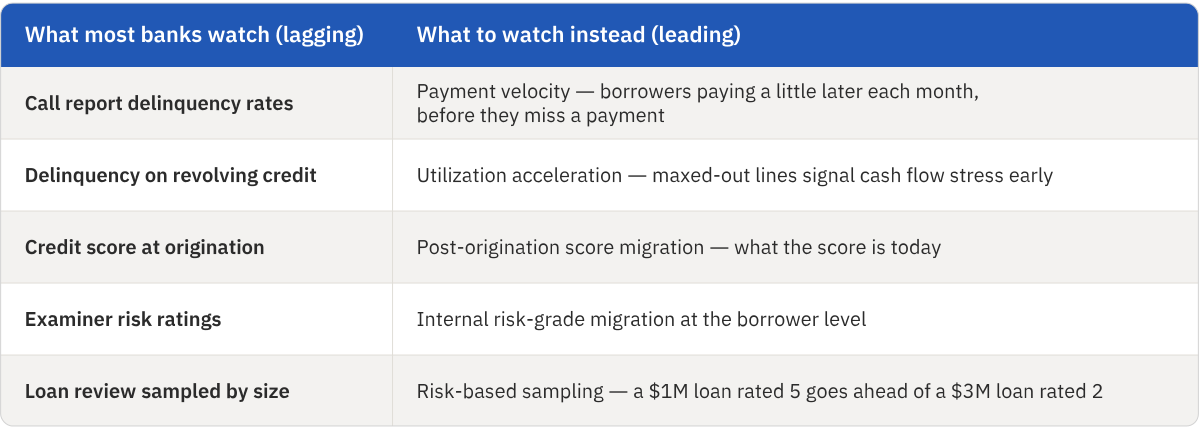
A portfolio can look fine on average and still be in trouble underneath. The tools most banks rely on — call reports and core system dashboards — were built to report portfolio-wide averages, not movement within segments. The FDIC's Quarterly Banking Profile has now noted that community banks are showing more credit stress than the banking sector as a whole.
What's inside
1. What the K-shaped economy means for bankers
How income divergence moves from consumer data into commercial portfolios, with a real example from a tourism-dependent community bank.
2. The credit cycle bankers can't ignore
Why 2026 marks the end of the longest benign credit cycle in modern banking, the complacency trap it created, and a 2008–2026 timeline in context.
3. Where risk is concentrating
Consumer lending, commercial real estate and self-governance — plus the CRE repricing problem and the growing gap in CECL reserves between institutions.
4. What the aggregate is hiding
What sits beneath healthy-looking GDP, unemployment, portfolio and sentiment numbers.
5. Six principles of best-practice credit risk management
From moving beyond the aggregate to tying every stress test to a named list of borrowers.
6. Action agenda and early warning signals
Seven steps to start with, and six signals to put on your dashboard now.
7. Board governance tool
Seven questions your board should be asking about credit risk, designed to share directly with directors.
Early warning signs to watch
A preview of the signals in the report:
Payment timing drift
borrowers paying later each month before they ever miss one
Revolving debt acceleration
lines maxing out before any delinquency appears
CRE repricing wall
loans approaching a balloon call in a higher-rate environment
Risk-grade migration
pass grades quietly weakening at the borrower level
Local unemployment uptick
even modest layoffs hit non-prime borrowers fast
Exception clearance slowdown
a governance problem before it's a credit problem
The CRE problem hiding in renewals
Most CRE loans amortize over 20 or 25 years but carry a balloon call every three to five. When one matures into today's rates, re-underwriting can push debt service coverage into problem-loan territory. Many banks avoid that by modifying at the original rate — keeping the loan off the criticized list but leaving the risk on the books.
The report explains why loans approaching maturity should be a priority sampling category, and how to stress-test debt service coverage against today's rates rather than the rate the loan was written at.
Questions your board should be asking
The report includes seven questions designed to share with directors. Two of them:
What percentage of our loan portfolio is exposed to borrowers in the lower arm of the K, and how is that segment performing compared with 12 months ago?
Are we watching internal risk-grade migration, or still gauging credit health by the call report — data that's already months behind?
Who should read it
CEOs and presidents deciding how much defensive work to start before the next exam
Chief credit officers and chief lending officers responsible for loan review, sampling and risk grading
Chief risk officers and CFOs working through stress testing, concentration limits and CECL reserves
Directors and risk or audit committees who need a clear, honest view of where credit is heading
Frequently asked questions
How does a K-shaped economy affect community bank credit risk?
Stress concentrates in non-prime households and in the businesses that depend on their spending. Because community banks often lend in exactly those segments and local markets, portfolio averages can stay stable while specific segments deteriorate. The report shows how to find that concentration in your own portfolio.
What are early warning signs of credit deterioration?
The most useful signals show up before delinquency: payments drifting later each month, rising utilization on revolving lines, falling credit scores after origination, and internal risk grades quietly weakening. Payment timing drift alone can give a 60 to 90 day head start.
What is "extend and pretend" in commercial real estate?
It's when a lender modifies a maturing CRE loan at its original terms instead of re-underwriting at current rates, keeping it off the criticized list. The report argues it's better understood as a repricing problem, and explains how best-practice loan review handles loans approaching balloon maturity.
How should community banks prioritize loan review sampling?
By risk, not size. A $1 million loan rated 5 should be reviewed before a $3 million loan rated 2. Arbitrary size-based thresholds are one of the most common ways risk goes unnoticed until it surfaces.
What should a bank board ask about credit risk right now?
Start with exposure to the lower arm of the K, how maturing CRE loans are being handled, whether the bank tracks risk-grade migration, and when it last ran a stress test that produced a named list of borrowers. The report includes seven questions designed to share with directors.
Why are community banks showing more credit stress than larger banks?
The FDIC's Quarterly Banking Profile has noted community banks are showing more credit stress than the industry as a whole, alongside a first-quarter rise in nonperforming loans and charge-offs. Concentration in local markets and consumer-dependent industries is a large part of why.
What is a K-shaped economy?
An economy where higher-income households and sectors keep growing while lower-income households and sectors fall behind at the same time. On a chart, the two paths split apart like the arms of the letter K.