










Insight
The penetration gap: what peer data reveals about your market position
See how peer data and the penetration gap reveal your bank’s true market position, relationship depth and untapped opportunities for growth.
There is a particular kind of executive discomfort that sets in when account volumes are up but margins are compressing. Growth can be a convincing disguise for loss.
When high-value households exit and lower-value households replace them, a stable account count conceals a weakening base, thinner relationships, and rising vulnerability to institutions that are more precise about whom they pursue.
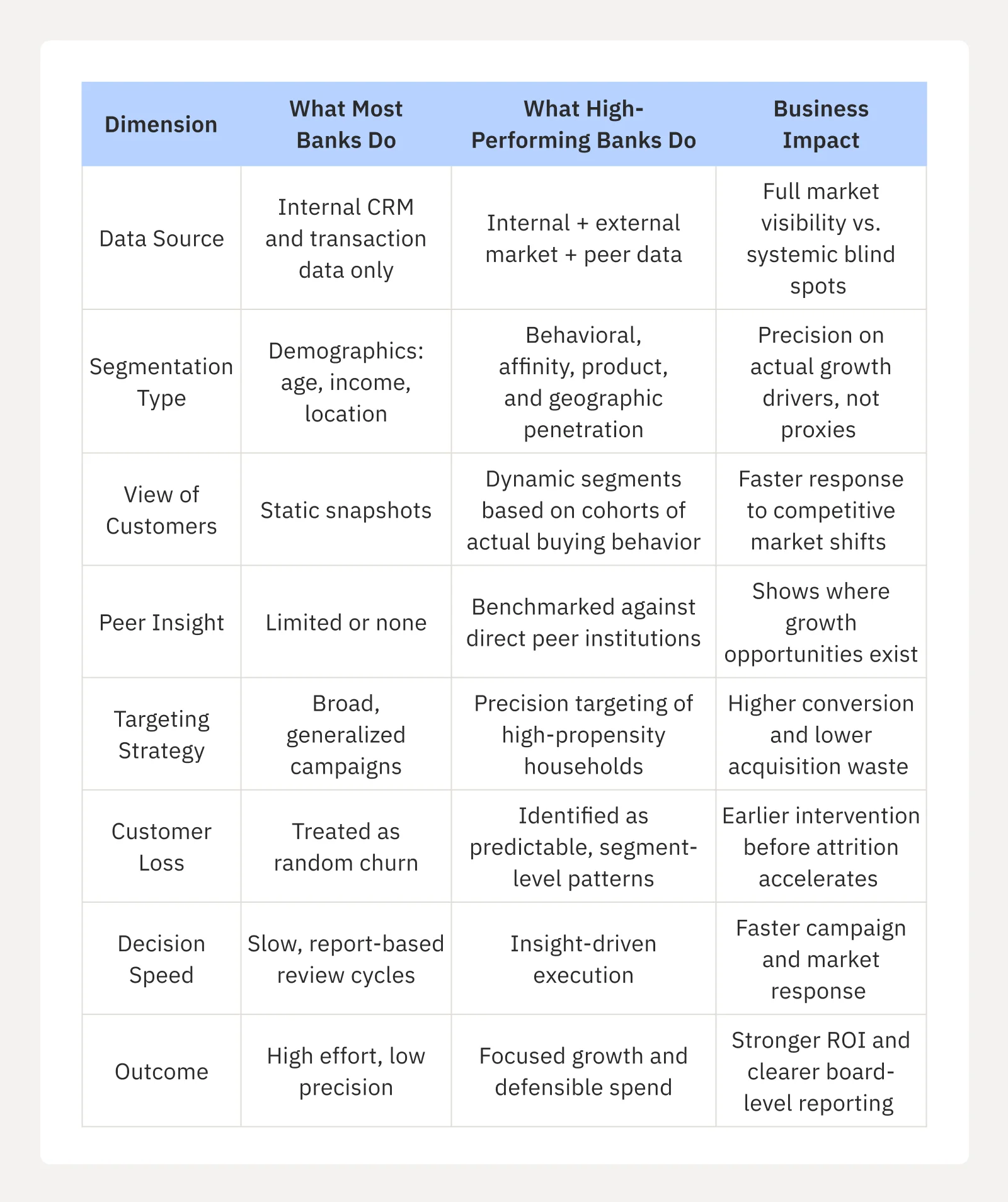
Most traditional customer segmentation models in banking are not built to detect this substitution. They describe the customers already inside the institution. They do not show which households are leaving, which segments are underpenetrated, or where the real growth potential lies.
Done right, customer segmentation tells community institutions exactly which household segments are underperforming, where the growth opportunities sit, and how to pursue them with discipline.
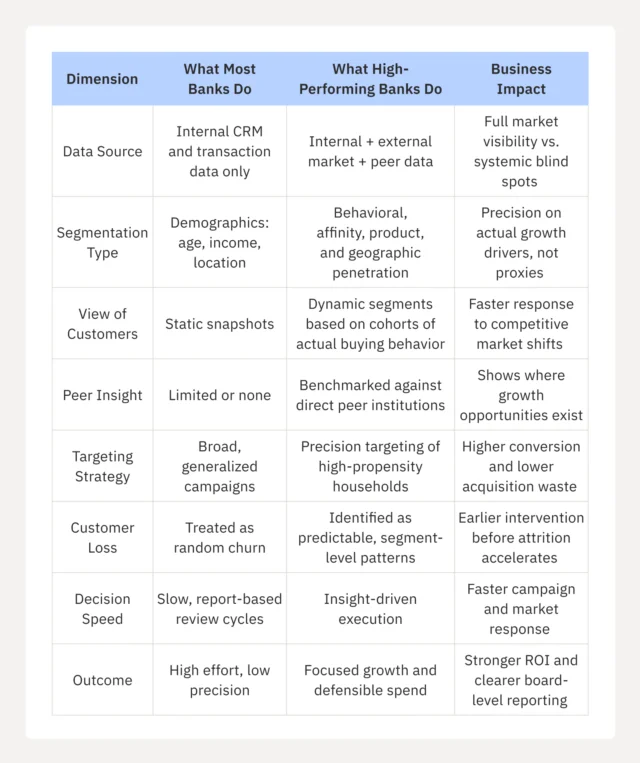
The standard model of customer segmentation is demographic: age cohorts, income bands, ZIP code boundaries, product ownership, account history. As a descriptive exercise, it works. It gives leadership a usable picture of the current customer base.
As a growth instrument, it falls short.
Internal segmentation tells you who your customers are. It says nothing about the households you could be reaching, the segments where you're underperforming relative to peers, or the growth sitting just outside your current book. That is the visibility gap.
High-performing institutions close it by integrating internal data with external market intelligence and peer normative data. That third layer changes the analysis entirely. Instead of measuring performance only against last year's book, the institution benchmarks against peer institutions pursuing the same households with similar product sets.
The Advocacy Advantage
Accenture’s 2025 Global Banking Consumer Study makes a related point: banks create more value when customers see them as advocates, not just custodians of accounts. That advocacy depends on deeper relationships, more products, and a larger share of wallet. Institutions that cannot see relationship depth eroding are already at a disadvantage.
Prospect acquisition plays by different rules than growth from existing customers. The difference is awareness.
Existing customers already know the institution. Prospects have to be convinced from zero. That gap means results build over time, and institutions that expect instant returns kill their programs just as they start to work.
Acquisition isn't an event. It's a discipline, and it runs in three stages:
This is what I've seen separate the institutions that win from the ones that don't: most programs die at the third stage. A campaign launch is treated as the finish line when it's barely the starting gun.
Expert insight: The institutions facing the most acute competitive pressure are not always the ones with the weakest products. Often, they are the ones with the weakest market visibility.
Institutions that win at new household acquisition do not simply outspend peers. They out-think them. Before a dollar goes toward prospect campaigns, they answer two questions.
Not every household in the trade area is worth pursuing. Some will never become primary relationships, regardless of the offer. Broad outreach generates volume. Precision generates value.
Start with the institution's own data. Analyze the demographic and behavioral profiles of the existing customer base — 70 or more distinct clusters — against the prospect universe in the market. This identifies the 10 to 20 household segments the institution already outperforms peers in attracting. Those are the highest-propensity targets. Peer normative data adds a second layer: which household types tend to respond best for institutions like this one, even before they show up in the book.
The result is a starting point sharper than a standard lookalike model — and one that gets sharper still as campaign data refines the picture.
New households, especially single-service ones, are the least sticky relationships in banking. Getting a prospect through the door is the easy part. The first 90 to 120 days decide whether the relationship sticks.
Skip onboarding and attrition erodes even the best-targeted campaign. Build it in instead. This is where acquisition ROI is won or lost.
Good data poorly acted on is a sunk cost. What separates institutions that win at new household acquisition is not just data quality; it's the discipline to act on it, and to keep refining.
Not every household earns equal investment.
Capacity asks whether the household can act on a given need: the deposit balances to fund an account, or the credit profile to qualify for a loan. Propensity asks whether they will, in the next twelve months. Budget follows both, not either alone.
A campaign launch is the starting point, not the finish line.
First-quarter response rates are never where they'll end up by the fourth. Winning institutions treat every campaign as a test: adjusting audience, channel, and offer based on what the data proves is working — not what seemed right at launch.
The discipline compounds. One institution saw new-to-bank households grow 19% in year one, reversing a multi-year decline, while cost per account was cut in half. Quarterly balances doubled, from $3.8 million to $8 million. By year two or three of a sustained program, cost per account often settles well under $250, sometimes even under $200.
What starts as a modest program becomes a growth engine the CFO can defend, the CMO can build on, and the board can understand.
The right audience through the wrong channel still loses.
I've tested this directly. For one client, we ran two identical audiences against the same checking offer; only the channel mix changed. One pairing combined digital media with connected TV. The other paired digital media with direct mail. Same targeting, same offer, same creative. The connected TV mix won decisively, driving a meaningfully higher average balance per responder and a stronger response rate.
No channel wins by default. Test the mix with the same rigor applied to the audience. That discipline is what separates institutions winning on quality from those just chasing volume.
The winning institutions pursue exactly the right households. They keep what they win. Every campaign sharpens the next one, because the data demands it.
Start with what's already inside the institution. Layer in what peers are proving works. Run the test. Read the result. Adjust, and run it again.
The payoff shows up in deposits, in loans, in accounts that stick around for years instead of weeks.
What is customer segmentation in banking?
Customer segmentation in banking is the practice of dividing a customer or prospect base into groups based on shared financial behavior, product usage, relationship depth, life stage, geography, or profitability. The most useful models go beyond demographics to incorporate product penetration, balance trends, and peer benchmarks.
What data is most important for effective customer segmentation in the financial sector?
The most actionable segmentation combines internal household-level data — products held, balances, transaction activity, and relationship depth — with external market data and peer penetration benchmarks. Internal data shows what customers do inside the institution. External and peer data show what the institution is missing in the market.
How do banks identify underperforming customer segments?
Banks identify underperforming segments by comparing their own penetration rates, balance depth, and product relationships against what peer institutions are achieving in comparable markets. Self-comparison shows direction. Peer comparison shows position.
How can segmentation improve acquisition and retention?
Segmentation improves acquisition and retention by identifying households with the right distribution of capacity and propensity. Those signals help institutions prioritize who to reach, what offer to make, and where retention intervention is needed before the relationship is lost.

See how peer data and the penetration gap reveal your bank’s true market position, relationship depth and untapped opportunities for growth.
Expose structural drivers of rising cost of funds by linking misclassified credit risk to mispricing and identifying performance gaps vs peers.
Assess your institution’s position across growth, risk, and balance sheet with a structured, data-driven diagnostic—no sales conversation required.