Why $50M in new deposits might actually be $12M





The Problem
Your campaign dashboard is telling you half the story, and it’s usually the expensive half.
When a community financial institution launches a new deposit campaign to capture more balances, volume is the metric everyone celebrates. Deposits flood into the promotional bucket, front-line staff hit their targets, and on paper, the campaign looks like an unmitigated success.
But when month-end financial reporting hits the executive table, a frustrating paradox often emerges: despite impressive new account activity, total balance sheet growth lags or may even be flat, while your overall Cost of Funds (CoF) has ticked upwards.
The reality sets in: your loyal, low-cost core depositors didn’t stay put. Instead, they simply migrated across your digital and physical branches to capture the premium rate. You didn’t grow total balances; you simply re-priced your most loyal, stable capital at an expensive premium, quietly eroding your net interest margin (NIM).
This blind spot creates a toxic cultural friction inside the institution. Marketing believes they knocked their volume KPIs out of the park, while Finance looks at the compressed margins and concludes that growth campaigns are just an expensive way to cannibalize the balance sheet.
The true villain isn't marketing or finance; it's the KPI. Without the data infrastructure to separate internal transfers from true Net-New household growth, you’re left operating in the dark, miscalculating acquisition costs, and treating an expensive asset shuffle as organic growth.
Run your own numbers
Most deposit campaign reports answer one question: how much did we raise? But total dollars raised and total dollars gained aren't the same thing.
When existing members move funds from a savings account into a new CD, the balance sheet doesn't grow; the money just changes buckets, and your cost of funds goes up.
The number that actually matters is net lift: the change in total household deposit balances, not just the balance in the new account.
Enter your last campaign figures below to see what your campaign actually delivered, and whether your institution is tracking the right number.
Where it goes from here
Your percent new money figure doesn't happen by accident. It's largely determined before the campaign launches, by the rate you offer and the households you target.
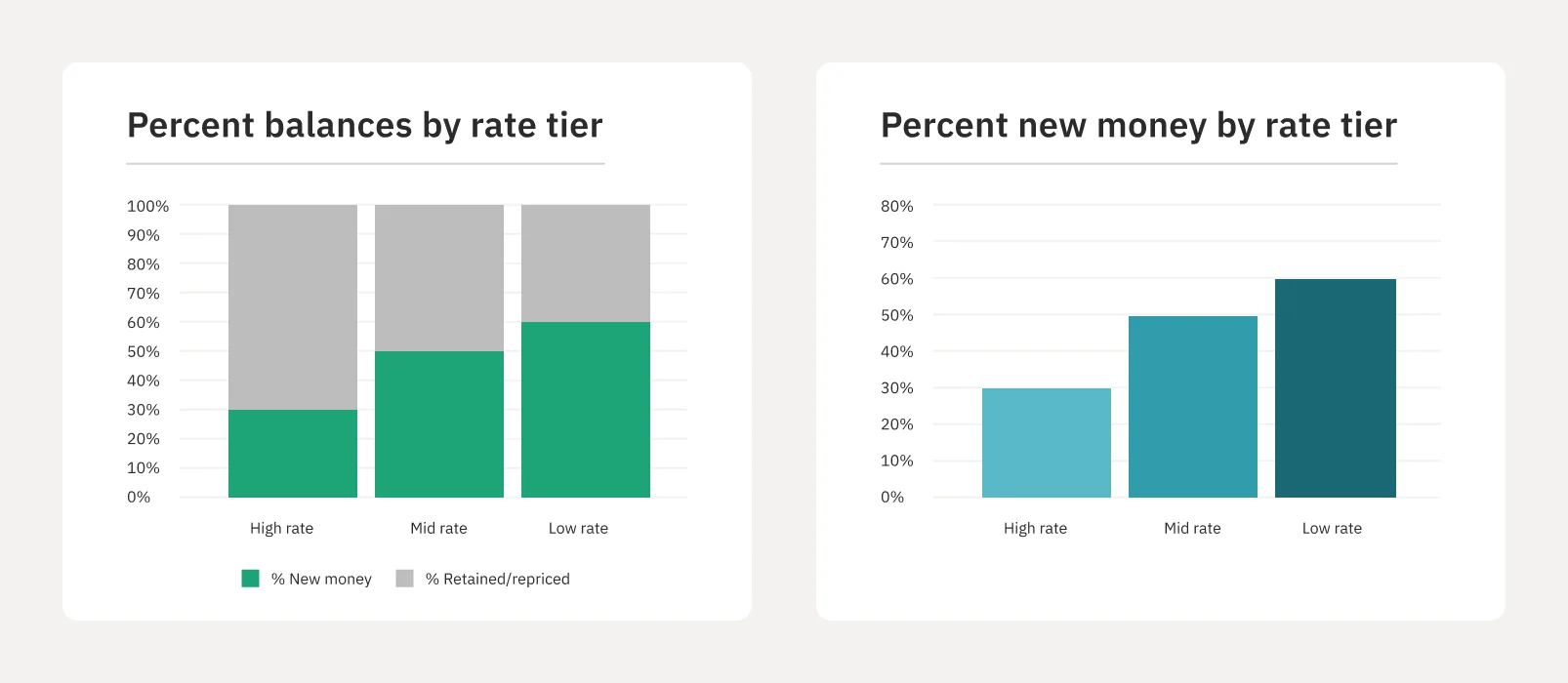
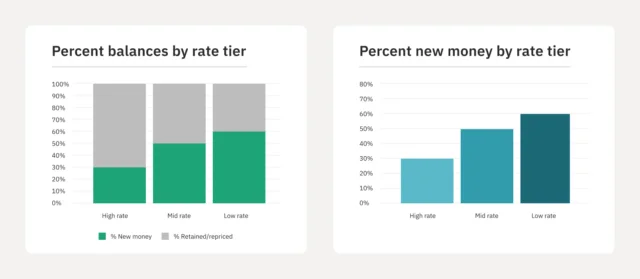
The data is consistent: higher promotional rates generate more volume, but a greater share of that volume comes from existing members moving funds they already held. A more moderate rate, offered to the right households, tends to produce less total volume but a meaningfully higher proportion of net-new deposits as well as a lower cost of funds.
This is the part most institutions miss.
The instinct is to compete on rate, to match or beat whoever is advertising down the street. But chasing the highest rate drives up cost of funds, attracts rate-sensitive money that won't stay, and creates maturity bubbles: large pools of deposits that were expensive to acquire and will need to be replaced when the promotional term expires.
The institutions that build granular, relationship-based deposit books don't win on rate. They win on targeting: reaching households with the capacity and propensity to expand the relationship, not just respond to a promotion.
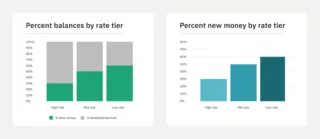
The charts below show how this plays out across three rate tiers from the same campaign type. As the offered rate increases, response balances grow, but the composition shifts. More volume, less new money, higher cost.
How does your institution measure up?
Most community banks evaluate deposit campaigns the same way: total dollars raised, accounts opened, cost per account. Those metrics tell you whether the campaign ran. They don't tell you whether it worked.
The questions worth asking are different.
- Are you using capacity and propensity data to reach households that can actually expand the relationship, or are you broadcasting a rate widely and hoping for volume?
- Are you choosing the right rate for customers vs prospects or just using a “high” rate across the board and chasing hot money?
- Are you reaching people across the channels where they're actively making financial decisions, or relying on email alone?
- And when the campaign closes, are you looking at what happened to the full household relationship: total deposit balances, not just the new account?
On cost, the instinct is to optimize for the lowest cost per account. But chasing the lowest CPA usually means offering the highest rate, which drives up cost of funds on every dollar that responds, including the ones that were already yours. The right target is a reasonable cost per account and an attractive blended cost of funds. Those two things together are what a well-run campaign actually delivers.