





Interactive Lesson, Insight
Lesson
Why $50M in new deposits might actually be $12M
Your campaign dashboard is telling you half the story, and it’s usually the expensive half. When a community financial institution launches...
Moving a posted rate takes an afternoon. Moving the rate you are promoting is the harder problem, and in a rate environment you cannot see coming, it is the one that decides whether a growth plan holds.
When most banks built this year's plans, the debate was how many rate cuts the year would bring. Now it is how many increases.
Nobody planned badly. The deposit targets, the loan budget and the marketing calendar were built on the same easing path nearly everyone was using, and it was a reasonable read at the time. What the reversal exposes is something most institutions have never had to measure: how long it takes to change the offer they are actually putting in front of customers. At most banks, nobody has ever timed it.
The Federal Reserve raised its benchmark rate by a quarter point in September, its first increase since July 2023.
The increase was the smaller news. At Jackson Hole in August, Kevin Warsh, the Fed's new chair, said forward guidance has "overstayed its welcome" and that in normal times its role "should be limited and circumscribed." Guidance became a regular Fed practice during the financial crisis, and markets have spent the years since learning to read it. Growth plans learned to lean on it too, usually without anyone saying so. If the chair follows through, there will be less of it to lean on.
So the honest planning assumption is that you will not get much warning. Everything else in a growth plan has to start from there.
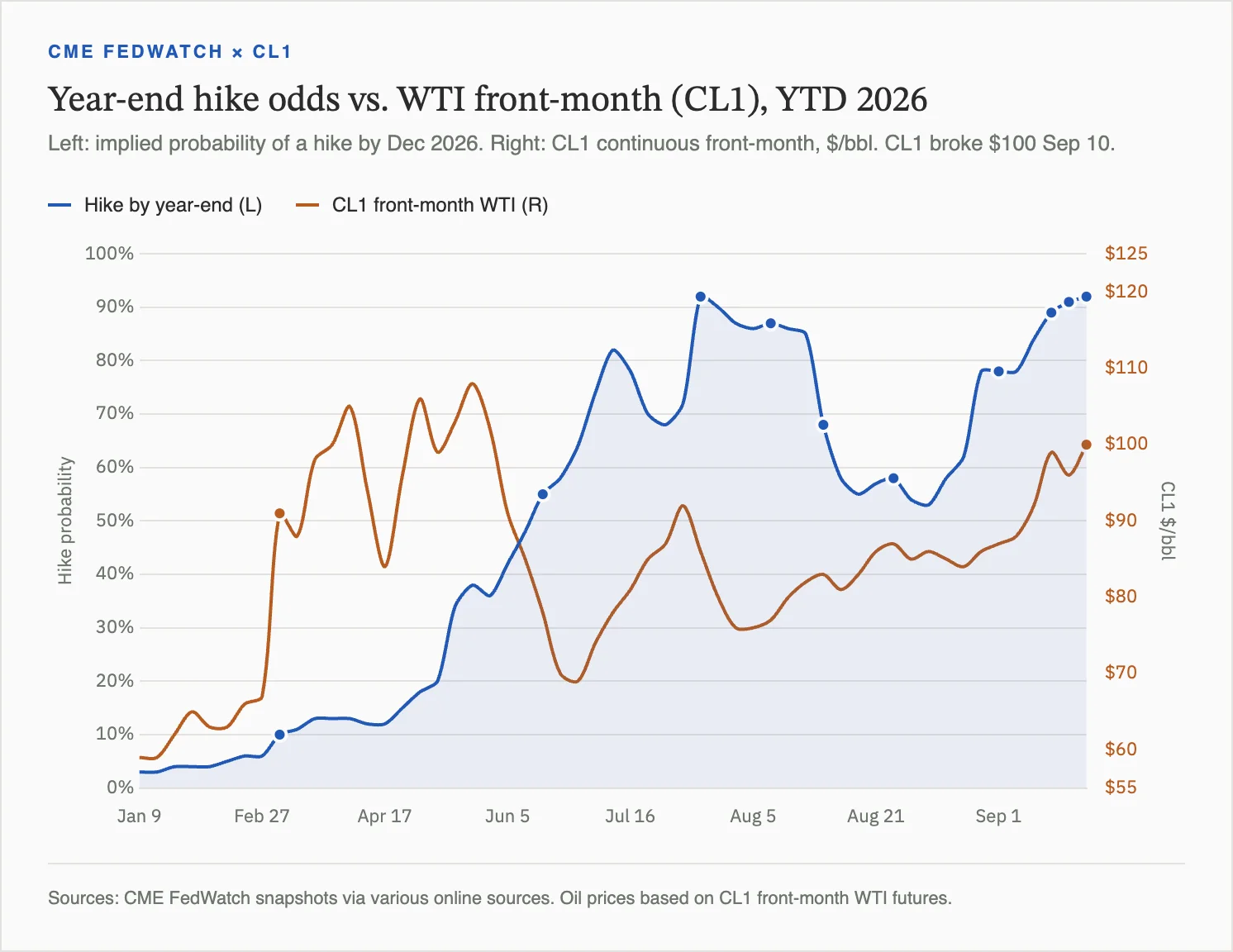
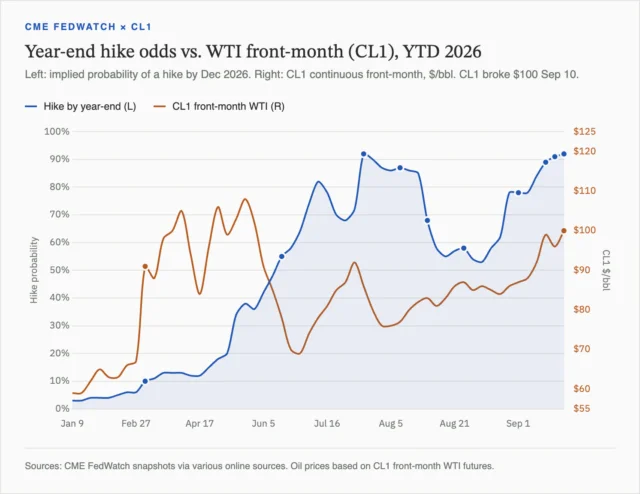
The number I am watching most closely right now is the price of oil. Oil feeds inflation expectations, and inflation expectations are what the Fed is reacting to. That makes it a leading indicator you can read daily, without waiting for a meeting.
The August inflation report showed how short that path is. The gasoline index rose 27.4% from a year earlier and accounted for more than a third of the month's increase in overall consumer prices. Five days after that report, the Fed raised rates and said inflation "remains elevated."
Crude's path this year makes the rest of the case. West Texas Intermediate opened January at about $57 a barrel, peaked above $114 in early April, fell to about $85 by mid-June and climbed back above $103 in September. A plan built around any single level for oil this year has already been wrong in both directions. A forecast that moves that far that fast is not a planning input. It is a reason to be able to move.
A posted rate is the rate on your rate screen, and most institutions can change it in an afternoon. A promoted rate is the rate in market inside a campaign, and it moves at the speed of the campaign, not the speed of the decision.
Ask a community banker how fast the institution can move on rate, and the answer is usually "same day." The answer is true. Updating the rate screen has never been the slow part.
The slow part is the promotional program. The promoted rate is the one doing the acquiring. It is on the postcard, the billboard, the landing page and the email, and at most institutions it was designed, approved and produced weeks before the market last moved.
So an institution can hold two rate positions at once. The posted rate reflects this morning's ALCO view. The promoted rate reflects a view from weeks ago, and it will keep reflecting that view until the flight ends. Most ALCO rate reviews only ever look at the first one.
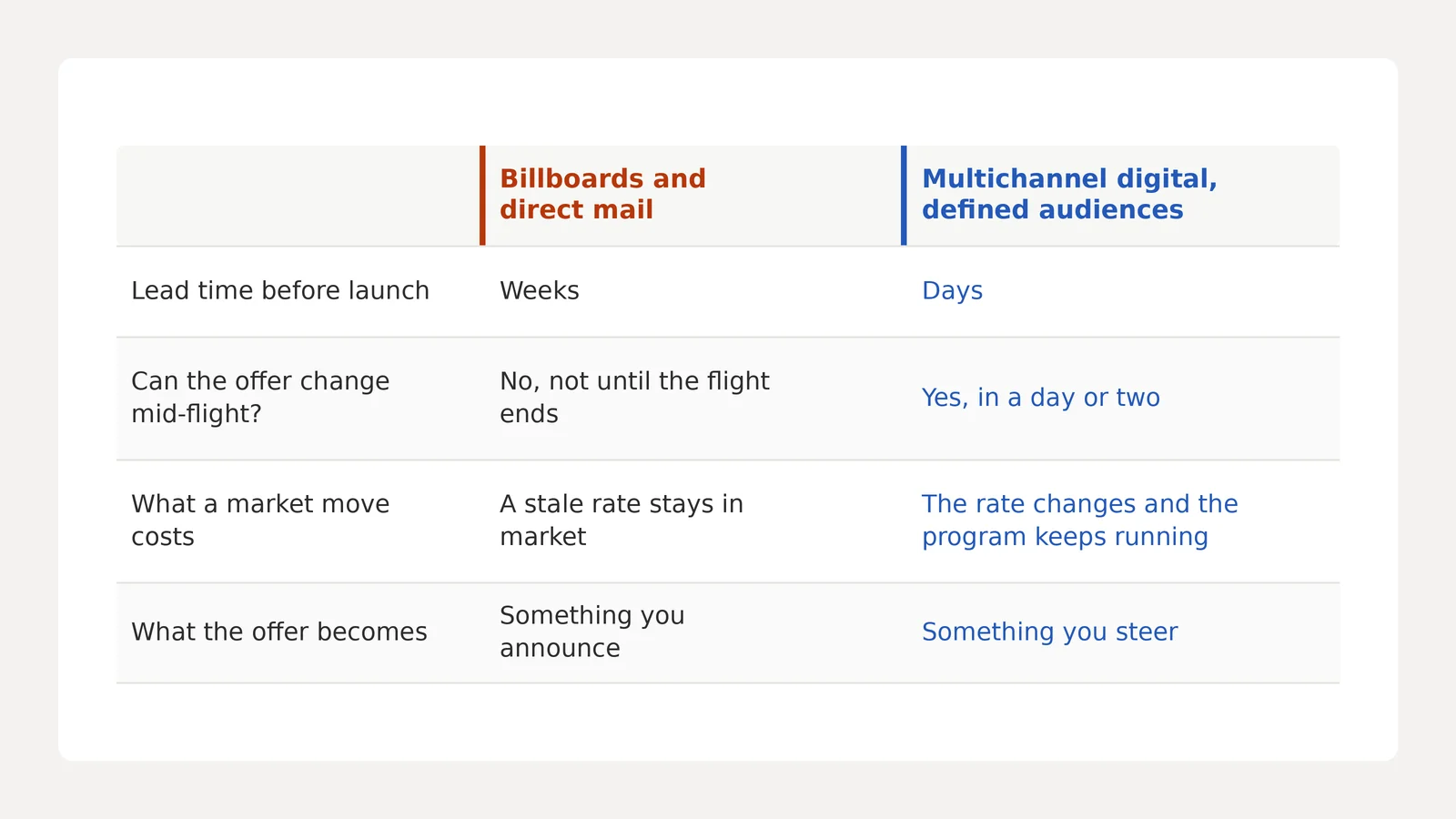
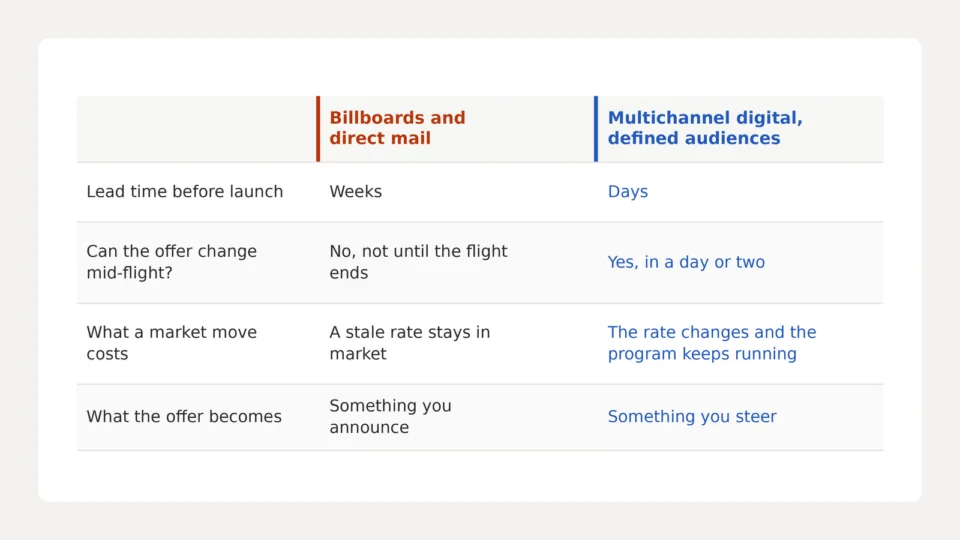
Direct mail and billboards still reach people, and plenty of community banks have sound reasons to keep them in the mix. What they cost is flexibility. A printed piece carries production lead time, and a media buy carries a fixed flight. A campaign lock-in is the stretch between committing a promoted rate to media and the end of that flight, during which the rate cannot change.
When the program runs through multichannel digital and speaks to defined audiences, most of that lock-in disappears. The promoted rate can change in a day or two. Side by side, the difference comes down to four things.
They key point here is that setting up the right combination of audience and messaging allows you quickly adjust the promoted rate or even pause the strategy based on shifting balance sheet priorities and environmental conditions.
If you do not want more fixed-term money, lower the promoted rate on it or pause the strategy entirely. If you want more money market and savings balances, raise the offer there. The mix shifts as conditions change instead of being committed in advance.
A deposit mix committed at the start of a campaign is a forecast about rates, whether anyone called it one or not. When the forecast is wrong, the balances arrive anyway, and the institution carries fixed-term money at a cost it would not choose today. Steering turns the mix into a dial.
None of this works if you are starting from zero. An always-on program is a promotional program that runs continuously against defined audiences instead of in lumpy big bursts, so there is always something in market to adjust.
Standing one up while rates are moving means scrambling, and the rush gets paid for in pricing. The cost of not having a proactive program in place is having to scramble and lean entirely on big promotional rates. I have seen time and time again how this just kicks the problem down the road by creating large waves of hot money balances that are looming 7, 9, or 13 months down the road. The opposite is proactively setting up an intentional and strategic program that allows you to build sustainable relationships with clients.
None of this requires knowing where rates go next. It requires being able to move when they do. A plan that only works in the rate environment you expected is not a strategy. In today’s environment it is a hope and dream. A better approach exists and we are helping bankers every day build strategic agility.

Your campaign dashboard is telling you half the story, and it’s usually the expensive half. When a community financial institution launches...
What would your last problem credit have looked like if you’d seen it six months earlier? The metrics most credit teams watch are outcome metrics.
Stress testing has been part of the regulatory conversation long enough that most institutions have done some version of it.