




















Insight
How peer benchmarking actually works — and why most banks get it wrong
Most banks misread peer benchmarking data. Learn how peer groups, metrics, and benchmarking methodology reveal real performance gaps and strategic insights.
Every Chief Risk Officer I've worked with loves a clean dashboard.
The quarterly portfolio report lands, the metrics are reassuring — delinquencies near zero, non-performing loans negligible, the commercial book firmly stamped with "Pass." There is real satisfaction in that moment. It feels like a validation of your credit culture, your underwriting discipline, your team.
That feeling is not unreasonable. But clean ratings and low risk are not the same thing.
Hidden inside that green bucket sits the soft underbelly of any commercial portfolio — credits that look fundamentally sound on paper today but are already exhibiting the early signs of a Watch or Special Mention credit.
Across portfolio reviews I've conducted in the commercial banking sector, roughly one in four Pass-rated credits carries structural, behavioral, or industry-specific anomalies that warrant a closer look.
If your rating system isn't capturing these shifts, you may as well be running a post-mortem loan shop.
A "Pass" rating is a classification, not a forecast.
Traditional credit ratings are an accounting snapshot of the past. A borrower can look completely sound because their last annual financial statement was clean, but in real time, they are already facing margin compression, supply chain distress, or macro headwinds that haven't yet shown up in a covenant calculation.
Is that a failure of intent? No — annual review cycles made sense when credit markets moved slowly. The problem is that they no longer do.
That gap between current rating and actual trajectory is what I'd call risk rating fluidity — the ability of a credit shop to update risk assessments as conditions change, rather than as reporting cycles dictate. Institutions that lack it share a predictable pattern: before a payment is ever missed, deterioration manifests in measurable early warning signals in credit risk — a sharp drop in operating deposit velocity, aggressive creep in revolving line utilization, or stretched trade payables to key suppliers. These signals are observable, trackable, and almost always present months before a formal downgrade occurs.
When fluidity is absent, these signals are overlooked. The rating stays at Pass. Then the borrower breaches a covenant or defaults, and the institution experiences cliff risk: a sudden multi-notch plunge, volatile spikes in CECL reserves, and the kind of regulatory conversation no examiner enjoys having.
Were the ratings wrong or were they stale?
When I audit commercial loan portfolios, a consistent baseline emerges: roughly 23% to 25% of Pass-rated credits carry underlying anomalies that warrant Watch or Special Mention designation.
What makes this figure important is not just the size but the consistency.
This isn't isolated to a few poorly managed institutions. It shows up across balance sheets of different sizes, geographies, and credit cultures. The pattern holds because the underlying causes are structural, not idiosyncratic. Institutions share similar macroeconomic pressures, similar underwriting blind spots, and similar human tendencies in relationship management. The result is the same portfolio decay, playing out at the same pace, masked by the same static ratings.
The critical takeaway is that these credits don't deteriorate overnight. The warning signals appear early — often months before a formal downgrade or covenant breach. The risk builds quietly inside the annual review cycle, invisible to a system that isn't designed to look between the lines.
That is a predictable phenomenon. Predictable means it can be measured, and measured means it can be acted on.
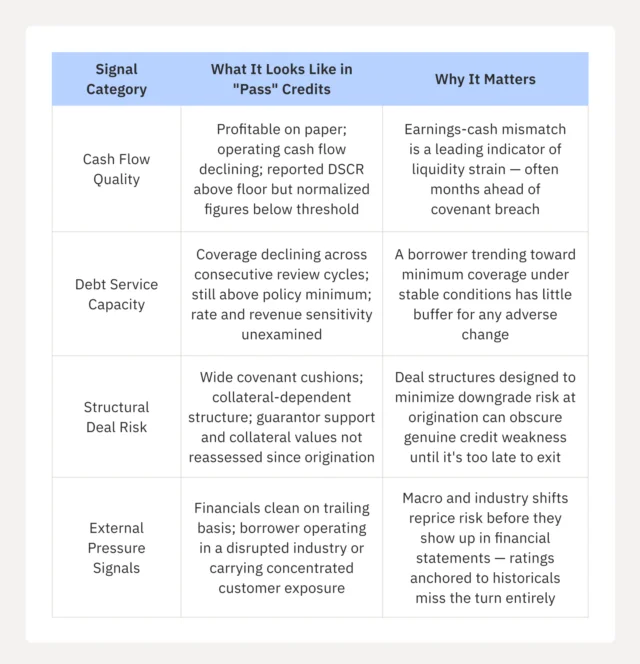
To isolate the credits drifting toward trouble, look past covenant compliance and examine the friction points where lagging accounting data masks real-time credit decay.
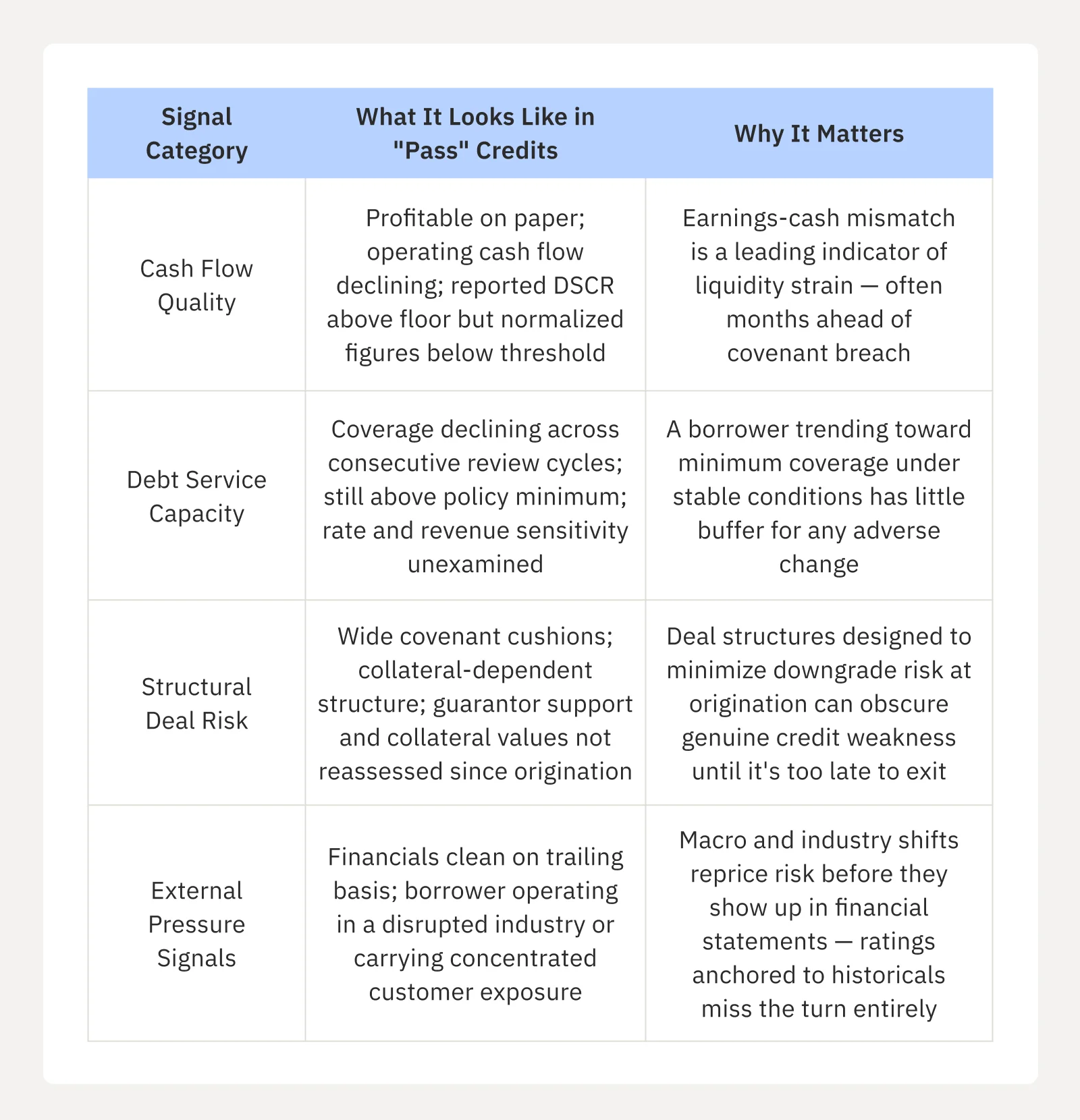
The income statement shows earnings, but the cash flow statement tells you whether those earnings are real. A common pattern in credits heading toward Watch is a widening mismatch between reported net income and actual operating cash flow — masked by one-time adjustments, deferred receivables, or aggressive working capital management.
The distinction matters: the reported DSCR may still clear the policy floor, but the normalized figure — stripped of non-recurring items — often does not. A borrower who looks profitable on paper but is drawing on reserves to fund operations is not a Pass credit. Point-in-time earnings analysis won't catch this. Trend analysis will.
DSCRs are almost universally measured at a moment in time. The more important question is directional: is coverage compressing, holding, or improving? A borrower whose coverage has declined across consecutive review cycles — from 1.45x to 1.30x to 1.18x — while remaining above the policy minimum has a trend line that is unambiguous even if no covenant has been breached.
A borrower at 1.25x and trending down is materially more exposed than one at 1.20x and trending up. Sensitivity analysis adds the next layer — what does coverage look like if revenue contracts five percent, or if variable rate exposure reprices? A rating that ignores trajectory and sensitivity is built on incomplete information.
Some credits are underwritten in ways that paper over borrower weakness rather than reflect underlying strength. Over-reliance on collateral liquidation value, wide covenant cushions, or untested guarantor support can make a marginal credit look clean — until the collateral is actually needed.
Structural conditions assessed at origination are not automatically reassessed at renewal. Guarantor financial condition changes. Balloon structures written at one rate environment mature into a different one. I've reviewed deals where the only thing standing between Pass and Special Mention was an appraisal that hadn't been refreshed in three years. The structure of the deal tells you as much about the credit as the financials do.
Industry headwinds and macro exposures rarely move ratings in real time. A commercial real estate credit backed by office tenants, a manufacturer with a single customer in a tariff-exposed sector, or a retailer facing category disruption — these borrowers can look healthy on a trailing twelve-month basis while operating in a fundamentally changed environment.
These pressures rarely appear in year-one financials. They show up in operating margins first, then in coverage ratios, then in payment behavior. By the time they're visible in standard metrics, the credit has already migrated. If the rating is anchored entirely to backward-looking data, external pressure is invisible until it hits a covenant.
The issue is rarely the quality of the credit team. I've worked with sharp analysts at institutions that still missed these signals systematically, because the process was designed for a different information environment altogether.
Standard reviews are built around siloed data: credit has the financial statements, treasury has deposit and cash flow behavior, portfolio monitoring has covenant tracking. You will not see these pictures sitting in the same room.
The result is that a borrower can show deteriorating deposit velocity — one of the clearest early warning signals I've observed — and that information never reaches the credit file. When the review is triggered by calendar rather than by condition, meaningful deterioration inside a twelve-month window is invisible until it's already a dilemma.
This is a structural problem, not an operational one. Examiners and credit officers working within a standard annual review framework evaluate credits against static, point-in-time criteria:
They are simply not modeling how sector-level pressure interacts with a specific credit's structural assumptions over a twelve-month window.
Most rating inputs also come from borrower-reported financials, prepared to present the institution in its best light. Forward-looking analytics and behavioral data are mere afterthoughts. If your process relies primarily on a point-in-time, borrower-reported credit risk assessment, these signals are likely already present in your portfolio.
You just don't have a mechanism to see them.
The starting point is segmentation. Not all Pass credits carry equal risk of silent deterioration; treating them as a monolith is how the 23% stays hidden.
Identify the clusters that warrant closer scrutiny: credits in sectors with accelerating macro headwinds, borrowers with rising revolving line utilization, deals with collateral coverage that hasn't been refreshed in recent cycles. Understanding how your portfolio risk compares to peers adds a second frame — is your Pass concentration consistent with institutions in comparable markets, or does it suggest systematic under-detection?
From there, align your credit, risk, and portfolio functions around a shared signal set for continuous monitoring, not just annual covenant calculations. Behavioral data like deposit velocity and line usage belongs in the credit conversation, not siloed in treasury. Institutions that do this have more strategic options when deterioration appears: covenant amendments from a position of strength, pricing adjustments that reflect actual risk, capital decisions made before the problem forces them.
The credit that migrates undetected is more expensive than the credit that migrates early — in reserve adjustments, in examiner focus, and in how hidden risk impacts funding costs as counterparties adjust to losses that were foreseeable earlier.
So how do you act while you still hold the leverage?
When you accept a monolithic "Pass" rating at face value, you are accepting a gap between what your borrower's cash position looks like today and what your desk says it looked like twelve months ago. The 23% carrying hidden decay are a direct consequence of that lag, and the relationship friction that keeps it invisible inside standard review cycles.
The banks that navigate a margin squeeze unscathed are the ones treating risk as a moving target. They've broken down the wall between treasury and credit so that a shift in a borrower's day-to-day cash behavior reaches the credit conversation before it reaches a covenant calculation.
Find them before they find you.

Most banks misread peer benchmarking data. Learn how peer groups, metrics, and benchmarking methodology reveal real performance gaps and strategic insights.
Learn how banks can improve customer onboarding, detect early attrition signals and turn new accounts into active, long-term household relationships.
Learn how customer segmentation and peer data help banks identify high-propensity households, improve acquisition and deepen customer relationships.